By Anjana Iyer (Fractional CDO, simpact AI)

When you sit in a room and hear, in the same breath, the full weight of what AI is currently doing to people, and then meet the proof that it can be done differently, it heals something in you, especially when you’ve been labelled a denialist or a hater for being cautious about generative AI. That is what the Auckland Writers' Festival gave us this past weekend. And I am still thinking about it.
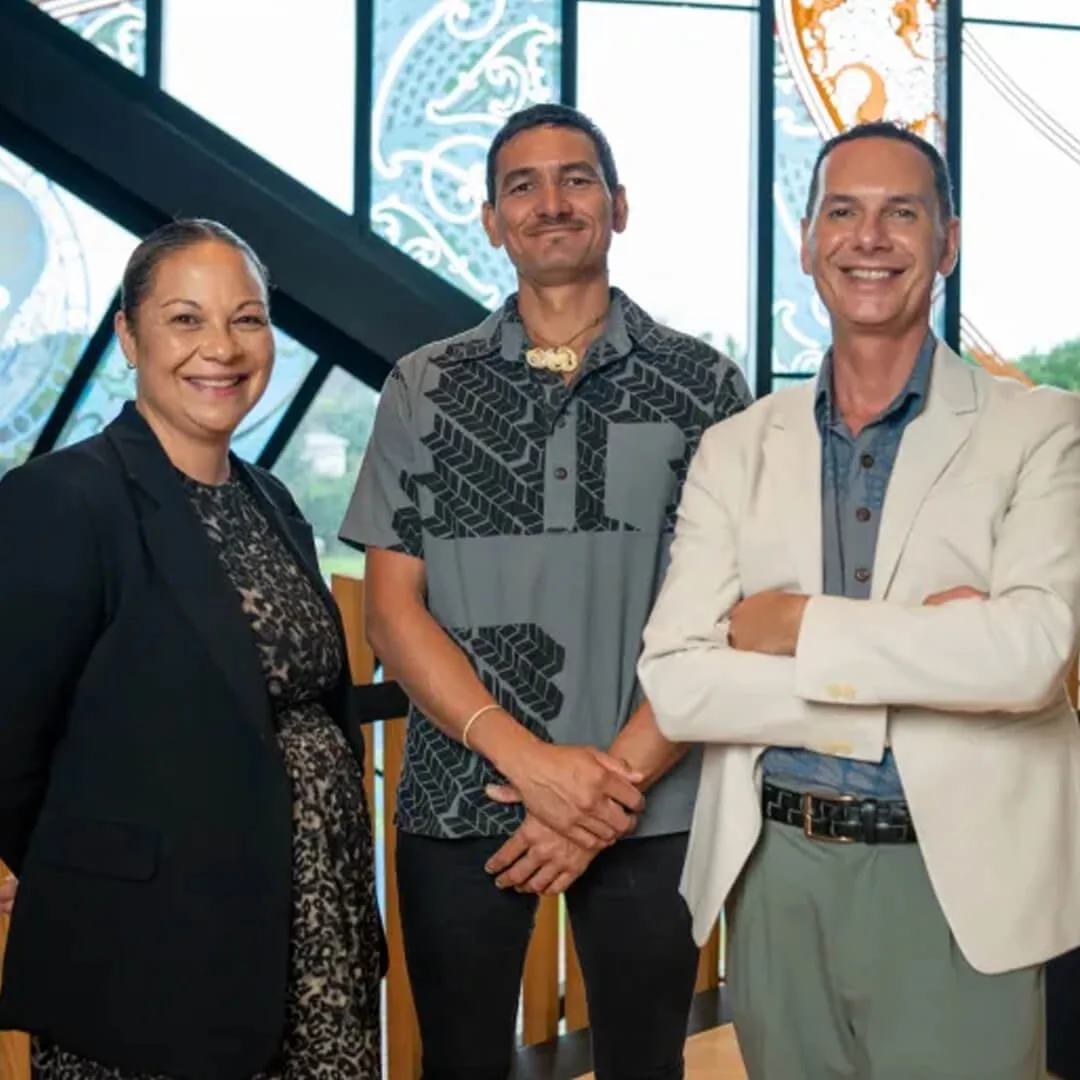
Karen Hao, investigative journalist and author of Empire of AI, opened the conversation. But the part I keep returning to, was the panel that followed: Hope in the Machine, featuring Peter-Lucas Jones and Keoni Mahelona of Te Hiku Media, a Māori-led broadcaster from the far north of Aotearoa that has quietly built one of the most important demonstrations of ethical AI on the planet.
AI is not inevitable and that's the point
Before we get to hope, we need to sit honestly with the context Karen Hao provided. The most provocative statement at this panel was that, AI isn’t good or bad, it is that the particular form AI has taken - hyperscaled, extractive, controlled by a tiny number of companies, is a deliberate choice, and one we can choose to resist.This matters because so much of the current discourse treats AI as an unstoppable force, like weather. We are told to adapt, adopt, and keep up. Never once stopping to think about where this is going and who’s paying the price. And tech leaders like Peter and Keoni are showing us, we can build this differently. In 2018, Te Hiku Media trained their first te reo Māori speech recognition model on just 220 hours of community-contributed audio, using a single chip. It took eight hours to train. That first model had an 86% accuracy rate, an outstanding achievement for a severely under-resourced language, built by a small team, centering Māori communities.ChatGPT's training, by contrast, is estimated to have required somewhere in the range of tens of thousands of chips running for six months or more, for the training run alone. The carbon, the water, the sheer material cost: none of it appears on a balance sheet visible to the public.Te Hiku took their 86% accurate model back to their elders. They sat with their kaumātua and kuia, listened to where the model was going wrong, and built those corrections into the next iteration. They were not chasing scale. They were chasing real accuracy, for real speakers, in real communities. By the time they reached 93% accuracy in their current model, every percentage point had been earned through care, iteration, and community feedback.This is the difference between building an AI god and building a tool.
Why inaccuracy is not a minor issue


Te Hiku's insistence on accuracy, and their method of improving it, is not just a technical preference. It reflects a deep understanding of what is at stake when models get language wrong for communities that have already experienced systematic harm.Inaccurate translations and transcriptions of te reo Māori are not neutral errors. They perpetuate colonial bias. When a speech model mishears or mistranslates te reo, it does not just produce a bad transcript, it encodes a kind of disrespect that Māori communities have experienced for generations, now automated and scaled. This is not a new finding. MIT researcher Joy Buolamwini's landmark work, documented in the 2020 documentary Coded Bias, showed that facial recognition systems from major technology companies like IBM and Microsoft, consistently failed to accurately detect darker-skinned and female faces, because their training data was drawn overwhelmingly from images of white men. The technical failure was also a statement about whose faces were considered default. In the same tradition, Timnit Gebru and her co-authors warned in their landmark 2021 paper On the dangers of Stochastic Parrots that large language models trained on uncurated internet text encode and reproduce societal biases at scale, and that the illusion of fluency masks how little these systems actually understand the communities they affect. This is why benchmarking and rigorously testing model outputs against community standards, not just statistical averages, is an act of harm reduction, not just quality assurance. It is why Te Hiku builds regular feedback from kaumātua and kuia directly into their development process. And it is why any organisation using AI to serve diverse communities must take bias auditing seriously: not as a compliance checkbox, but as an ongoing obligation.
The contrast between Te Hiku's approach and the Big Tech extraction model
I want to break this down as simply as possible, because I think it is the most important thing this festival surfaced. The contrast between Te Hiku's approach and the Big Tech extraction model could not be more stark. I want to lay it out plainly, because I think it is the most important thing this festival surfaced.Let’s start with data. Tech giants like Claude, OpenAI and Google scrape internet content without explicit consent, retain ownership of everything they collect, and build models that primarily benefit shareholders and paying users. Te Hiku did the opposite: every piece of training audio was community-contributed, gathered with informed consent and elder blessing, and the data belongs, legally and in principle, to the community that created it, protected by the Kaitiakitanga License.Then there is scale. Big Tech builds toward AGI at whatever environmental and human cost that requires. Te Hiku's ambition is specific: te reo revitalisation, community access, language survival. Their first model ran on a single chip, in eight hours, trained on 220 hours of data. OpenAI's training, by contrast, required tens of thousands of chips running for months. The labour contrast is just as stark. Big Tech runs on data annotators in the Global South, doing precarious work, on wages of $2/day with limited protections. Te Hiku built their model with community kaimahi, kaumātua, and kuia: people paid a living wage, respected, and whose knowledge is stewarded rather than extracted. Their quality control is not a statistical benchmark, it is iterative feedback, because accuracy is an obligation, not a metric. The Kaitiakitanga License that governs Te Hiku's data is worth understanding in its own right. It explicitly prohibits using the data for surveillance, discrimination, or the building of Māori corpora outside Te Hiku's governance. It is grounded in Te Mana Raraunga - the Māori Data Sovereignty Network's principles, and in tikanga: Māori customs and protocols.
Small models, specific purpose, shared benefit
One of Karen Hao's most useful framings was her analogy: AI is like transportation. You could be describing a bicycle or a rocket. The problem is that the entire industry & public conversation has been captured by rocket logic: bigger models, more parameters, more data, more power, universal application.
But small, purpose-built models have real and demonstrable advantages. They are faster and cheaper to run. They are easy to update when they go wrong. They do not need to be a one-size-fits-all, poorly-calibrated behemoth to be useful. In fact, I reckon that universalist ambition is precisely what makes large models so bad at serving communities whose contexts, and needs were not represented in their training data.
Te Hiku's model was built to transcribe te reo Māori accurately, to serve Māori communities, and to be governed by those communities. That specificity is the entire point. Their goal is to serve more of our community, faithfully and equitably. That requires care and curation at every stage: care in what data you collect, how you collect it, who you collect it from, and how you give back to the people who made the model possible.
Literacy is resistance
So where do we go from here? Sitting in that room, I found myself thinking about the position all of us are in, as individuals, as organisations, as communities.
AI integrated systems have been part of our every life from search results, credit scores, to social media algorithms and music playlists, regardless of our conscious choice to use AI tools. The answer, I think, is literacy and the capacity to ask: Who built this? On whose data? With whose consent? And who benefits from this? Who was paid, and how much? What happens when something goes wrong, and who is held accountable?
Asking those questions leads towards preserving our agency, and demanding consent-first data practices. It means supporting organisations that pay data workers fairly and treat community knowledge as something to be stewarded, not extracted. It means insisting that models are benchmarked, audited, and corrected, continuously, and by the communities they affect. It means building and choosing smaller, purposeful tools over monopolistic platforms that lock in dependency and concentrate power.
At simpact AI, that same question sits at the centre of what we are building. Our platform exists to help community organisations, NGOs, nonprofits, grassroots groups, tell their own stories of impact, in their own words, without that work being extractive or inaccessible. That means the community retains ownership of their stories and data, the AI augments rather than replaces human voice, and the people most affected by the work have a final say before anything is published or shared. Building intentionally means building accountably, and that is a commitment we intend to grow into, not just declare.
If any of this resonates with you, I want to leave you with some links to look into. The work of building AI differently is not just for technologists. It is for funders who decide what gets resourced, for communities who decide what tools they adopt, and for anyone willing to ask harder questions of the platforms they use every day.
Here are some resources I rely on to learn more and take action:
AI Resist List - A curated guide to challenging extractive AI practices
Pulitzer Center AI Spotlight Series - Accountability journalism and educational resources on AI's societal impacts
Polisync Learning - Tools for civic and policy engagement in the AI era
All Tech Is Human (LinkedIn Learning) - Responsible tech education centred on human values
Mystery Hyper Theatre 3000 (Podcast) - Linguist Prof. Emily M. Bender and sociologist Dr. Alex Hanna break down the AI hype
Empire of AI- I’d be remiss not to share this book. It’s not an easy read, and I struggled on some days to read more than a few pages, but it helped shape my thinking and reinforced my faith in building community power and data sovereignty, and made a solarpunk future feel worth organising for.